Thursday, 30 September 2010
Tortious Interference and the Caricature Case
One should not take liberties with the freedom of speech. Each right has its own set of duties. I have the right to drive from A to B. But however I must attend to others. It would be inhuman to drive from A to B and kill people in the course of the journey. So it is with writing and speaking. For example, I may wish to call Flemming Rose the editor responsible for the caricatures and a new book which have created so much tension in the world and deaths, an asshole. Of course this is offensive. I expect he might be hurt by that. If he is. Then surely that might signal to him that words do hurt. Of course they do. They can cause people even to commit suicide. Perhaps Rose is hardened to all of this, as he is a journalist, and daily at the receiving end of nasty comments. However, we also saw that when someone threatened to do physical injury to the leader of the Danish People's Party, even though it was in the form of an email, he was found culpable. There are numerous examples of where we must take care of what we say, other wise face criminal or civil action. Words and images do harm. I believe that the publication of the caricatures was calculated to do harm. It was offensive to the Moslems in Denmark, many of whom are disadvantaged. This is equivalent of making fun of the homeless or the disabled. While one has the right to do that - one also has special duties towards them. We are all mature now, and understand that when we make fun of someone, we must consider their status, and more importantly whether it will harm them personally. Those are duties. The laws of Denmark and the EU were exhausted in trying to find a means of preventing the publication, and compensation for the harm. There were serious problems with the laws of blasphemy - they were in the balance more harmful than good. Now, in the light of all the trouble which arose from the first publication of the caricatures, I would like to argue for an unlikely legal instrument for preventing further publication of Rose's book. It is tortious inference. Here we see the publishing house, and Rose, as tortfeasors, "who intentionally damage the business relations" with Moslem nations. During the height of the response to the first publication of the caricatures, Danish companies lost millions of kroner in revenue. This economic loss was made public, and it is argued that Rose and his publishing house, know that the publication of the latest book will surely damage the business relations. Even so, they went ahead, believing the right to publish is more important than the harm it causes, whether it be mental, physiological or in thise case economic. Now, if the companies who stand to lose money were to act, they could obtain an injunction to prevent further publication on the grounds that they might incurr severe economic losses if it were to go ahead. They could take it to the EU courts - who may be willing to support such a measure.

Friday, 27 August 2010
Poetry and the Petit-bourgeois
Pettiness and poetry. Handmaidens of the margins? Increasingly I find myself coming to the conclusion that poetry is really a form of Sunday pursuit. That it is like painting by numbers. Even those who willfully refuse to paint in the required places - will do so in a conventional way. Their revolt is like those who use cash instead of a credit card.
to trade in stereotypical train spotted fare paid for by grievous
harm to the body of literature which the bastards holday in,
(from "Thistle I" , 2010)
Then there is the stand-up - Wikicommons remix approach to writing that wishes to muck up the form and take no risks except maybe a bit of abuse to one's own person.
of the joke, your language conserved and preserved like a battered Mars bar,
to make funny with the expression, och jimmy, och, och, fuck, fuck, fuck
(from "Thistle I " 2010)
What is the end of all of it? Baying at the ATM machine? Often it is:
cobalt blue thoughts, arabesque fantasties
which rhyme with expensive wall tiles
and they end up with other polished
artifacts that meet the house styles
of arts council funded magazines
where the finished product reigns
(From "Tired of" 2010)
Is everything said? Do we now need poetry installations and swing our genitalia about publically - or is that old hat too? Who cares? Are the readers like those who collect kitsch glass horses and place them about their caravans looking across from Weston to Wales? Or do we
Delight in the swing, hazard the future
(from "The Swing" "2010)
Yes indeed.
to trade in stereotypical train spotted fare paid for by grievous
harm to the body of literature which the bastards holday in,
(from "Thistle I" , 2010)
Then there is the stand-up - Wikicommons remix approach to writing that wishes to muck up the form and take no risks except maybe a bit of abuse to one's own person.
of the joke, your language conserved and preserved like a battered Mars bar,
to make funny with the expression, och jimmy, och, och, fuck, fuck, fuck
(from "Thistle I " 2010)
What is the end of all of it? Baying at the ATM machine? Often it is:
cobalt blue thoughts, arabesque fantasties
which rhyme with expensive wall tiles
and they end up with other polished
artifacts that meet the house styles
of arts council funded magazines
where the finished product reigns
(From "Tired of" 2010)
Is everything said? Do we now need poetry installations and swing our genitalia about publically - or is that old hat too? Who cares? Are the readers like those who collect kitsch glass horses and place them about their caravans looking across from Weston to Wales? Or do we
Delight in the swing, hazard the future
(from "The Swing" "2010)
Yes indeed.
Thursday, 26 August 2010
Compassion

Is there no greater human virtue than compassion? Probably not, because empathy or fellow suffering is entailed in the act and thought of compassion. Maybe it has evolved from altruism that is hardwired in other animals, but it has emergent properties that are connected with higher cognitive processes and social networks - though of course those of a religious frame of mind and heart will declare it to be a product of spirituality. In religions it is "compassion: Christianity; Daya: Hinduism; Rahman : Judaism and Islam ; kuruna: Buddhism. It is universal. So why is it not practiced more? Why is it that when we see someone who believes differently, dresses differently, has a different skin colour, has different tastes, is just plain different - we feel disgust or hatred. Why do we hate the criminal? Why do we hate the terrorist? Must we hate them? Is that what it is to be a civilised Westerner or Easterner? To hate. I feel that it is too easy. We can all cut the legs off an insect. We can all pass comment and judgement on others. We can call them names, we can throw stones at them. It is all so easy. Everyone has the power to kill another person. But the hardest thing to do is to practice compassion - and you need not be religious to practice this - I am not. I think we can take baby steps - starting with tokens and gestures -when we comment on the internet - seek a pragmatic approach. When people fly off the handle and attack a person - tell them that you have compassion for the object of their fury - this does not mean you condone violence or hurt - it means that you can understand and feel for them - you need not forgive either - it is to say that if an illegal immigrant steals - you do not start on your high moral road - from a position of comfort and righteousness - but you must feel as they do. You must become like in the Stanislavsky method - that person - and then your perspective will change. This does not mean that you love or hate them - it is just that you move towards a greater appreciation of the complexity and difficulty of the human condition. It is not liberalism or communism. It is a humanist position - grounded in a social and cultural empathy. I have tried and failed numerous times. But I think that general direction is a good we should aim for - one that gives not salvation or rewards - only a restoration of our humanity.
Saturday, 26 June 2010
Sheep

I was on the bus and thinking about black sheep. How that might be deemed politically incorrect today, but I wondered, as one does, about its origins. There is of course the nursery rhyme as well, which was about the only one I could remember, and actually enjoyed. The origins of this nursery rhyme and its variants are discussed here:
http://wapedia.mobi/en/Baa,_Baa,_Black_Sheep
I remember as a little boy in Weston-Super-Mare singing my heart out, and never realising the history behind it, nor of course the ubiquitous "Ring a Ring o' Roses". I then thought, and now I am proved wrong, that it was all to do with the 1665 Plague. But oh no, folklorists have corrected that origin:
http://wapedia.mobi/en/Ring_a_Ring_o%27_Roses
The thought of the sheep, got me thinking about just how much do I know about this ruminant. I do know now that there are 200 breeds, of these I am most familar with the Cheviot breed because this is found in Northumberland where I went to school, and the Merino. I saw Cheviots every day when I lived in Longhoughton, and moreover, despite being quite young, spent a great deal of my time chatting with a retired shepherd who used to use the stone wall near my parents' house as a resting post. He told me about the weather, the kinds of animals and birds you would see, etc. He struck me as an ideal figure - so much that when I did a career test to see what came up for ideal occupation - Bingo - shepherd. Of course the reality is anything but romantic. It is certainly not a job for me today. As I walked the hills once I heard about how sensitive the sheep were. How they were prone to heart attacks - and I can see why the Monty Python "Killer Sheep" sketch is so uproarishly funny:
http://www.ibras.dk/montypython/episode20.htm#7
What I saw of sheep, excepting the rams, were animals that were timid and flock minded. They would scarper if one stepped into their safety zone. Running up swifly the hills, with a sure-footedness that did not quite go with their shape. Now I also know that the domestic sheep bred from the Mouflon has undergone some incredible changes - I have seen paintings of sheep in the eighteenth century and they look bizarre. Actually, my memory has confused cattle with sheep, the sheep in Thomas Gainsborough's study can surely enter a flock today unnoticed:
http://www.ibras.dk/montypython/episode20.htm#7
Whereas the cow of the 18th century was bizarre:
http://austenonly.files.wordpress.com/2010/01/welch-cow117-correction.jpg
But the Merino with those short legs to prevent it from jumping over fences, now that is quite removed from the wild sheep.
We are all familiar with the Christian iconography and the image of Christ as a shepherd and the followers, as a flock. I again, love Psalm 23, because of the rhythm - I doubt if I paid attention to the message:
http://zemirotdatabase.org/view_song.php?id=28
For the Jews and Christians David and Jesus and other figures were seen as shepherds, and the people as a flock. What do flocks do? Well they follow rather blindly. They will follow a leader, and in sheep it is not the strongest one, but the one who reacts first. I am not so sure it is good metaphor of the prophet to people relationship. The Final Solution was based on flock mentality.
What also of the image of the people as sheep? Well, here Christ as the sacrificial lamb gives us a clue, because in earlier cultures, the sacrifices were human. The lot of sheep is not a very happy one.
This is how sheep were killed in the old days:
http://www.leafpile.com/TravelLog/Romania/Farming/Slaughter/Sheep/Sheep.htm
Friday, 25 June 2010
On the Precipice

I do not really know why I like this title, but I suppose, firstly I suffer from vertigo, and being on the edge of a precipice would quite frankly scare the living daylights out me. I also like the sound of precipice, it is one of my "Desert Island" favourite sounding words. There is also a connection with another word I like, sublime. The two of course are connected in art. The lonely figure on the edge - oh how Romantic! The painting above "The Bard" (1814) by the English painter, John Martin (1789-1854) and the paintings of Caspar David Friedrich (1774-1840) for example "The Wanderer above the Sea of Fog" (1818), capture quite nicely the feeling of being on a precipice. It puts oneself in perspective with regard to the big picture of Nature or God. I think the metaphor of being on the precipice, suggests to me, a change of such enormity, that one might be changed forever. Do we stand on the precipice today? Perhaps so, the very Nature that we have worshipped for thousands of years, is slipping away from us. Maybe there is no Nature today, only Artifice? If so, why do we let one animal rip into another, when we know that the latter is rare or beloved, should we not intervene? Is it a form of negligence when a documentary maker leaves a cheetah cub to be consumed by a hyena? Or should we continue with the pretence and let Nature take its course? What about, staying with the media, the possibility that we cannot act outside the Media, and that its interests direct our lives, and run our governments? Why would the President of the United States eat fastfood with the President of Russia, except for the pressure of a popularist driven Media? Are we on the precipice of not existing in our right, except as an avatar of the Media?
Then there is Art. I love art. Now where is the art in Art?
Wednesday, 23 June 2010
Impolite Conversation

The title of this essay, was suggested by Aldous Huxley's "Polite Conversation" in On the Margin, Chatto & Windus, 1948 (orig. 1923). His essay was really a review piece, but it got me thinking about the nature of conversation. Jonathan Swift did a wonderful satirical work based on all the cliches used in his period., A Complete Collection of Genteel and Ingenious Conversation (1738) - a fun book indeed. If I think of the current dialogues, well they rarely aim towards the polite, most are "in your face" snipes or snarls. We converse like curs. "Fuck you!" "Yeah, fuck you." "What's up?" "Nothing." "You." "Nah." Where is the sense of decorum? We think it can take a hike, because the civilizing process of Norbert Elias was after all but a colonial endeavour, to enslave and divide. The handshake is derived from primates greeting each other by sniffing their butts and fondling their genitalia. What is there to be polite for? Far better to tell the other party how you feel in a direct and equalitarian manner. So if the serotonin levels are ascendent, then one lets loose an oral fart. If you stitch, if you can indeed stitch gas together, these snarls and snipes, what do they constitute? Well often, if they do run for more than a stack of monosyllables, the Anthony Burgessian grunts, then they form extended Q &A. "Did you see the match?" "Didya see the youtube?" "Didya" Invariably, the response will be "Yeah" or "Nah". "It was wicked". Perhaps, to bring Aldous Huxley back again, the youtube of Lady Gaga gagaing was to his coenobites, an example of the fornicatio . Not that they didn't hump each other, to double negativize, or have lewd thoughts about others whilst in their state of acedia. It is also to be noted that this terseness has something to do with the noise factor. You know the Étienne Lombard effect: it is when in a pub one person talking to another has to compensate for the environmental noise level, and talk louder. The fellow interlocuter follows suit, until both parties are screeching. Although we have the possibility to filter and focus on one conversation (the cocktail party effect), we often end up shouting monosyllables. Under the influence, these monosyllables become slurred. "Deeeeeeedyaaash?"Can be translated as "Did you?" With all these factors, plus a score of neurohormones kicking in or passing out, there is scope for aggression as a consequence of a simple misunderstanding. Since, conversation comprises of 90 percent nonverbal language - a prolonged gaze at someone's partner, can land the viewer with a punch in the face - or worse. "Whaddyafinkyafakkindoingmate?" Indeed. At this point you might say in your defence, that fornicatio was not on your mind and that you are celibate as a paperweight. "Youtryyinbefannyyafakkinkunt?" It does not work. You are left to do a Bruce Lee. Run. You can get into these little contretemps by trying to break the ice at a bus stop. Your opening gambit, the one preferred by the Brits, might be. "Nice day today isn't it?" "You gay or something?" Or "We have had a load a rain these past weeks." "What does that have to with me mate?" Or "The precipitation levels are a mark above normal?" "You foreign, ain't you?" A conversation about the World Cup or football is very dangerous, and to be avoided at all costs, unless you recognise the scarf or T-shirt and you can converse on the topic for more than two minutes.
Wednesday, 16 June 2010
The E-Book Revolution

The E-book revolution would be furthered if every college and university student was issued with an e-book that contained the set text books and compendiums for the relevant degrees. The E-book would be paid for over a period of the degree.
High Society Portraiture

This is a photograph of Princess Margaret by the fashion and portrait photographer Cecil Beaton (1904-1980). It has much in common with the earlier photographs of royals like this of one by Jack Stack Lauder of the future Queen Mary, Princess Victoria of Teck below. Both photographs are intended
to promote the sitters as fashionable and feminine. However, despite having modern hair styles, both princesses have anachronistic and very formal dresses. In the case of Princess Victoria the corset is constricting like one we would expect of the mid-Victorian period. Despite so many innovations, Beaton’s photograph has the design typical of a staged painting. Interestingly, the John Singer Sargent (1856-1925) paintings seem to have taken their cue from portrait photographs. As in this one:
Sargent was undoubtedly one of the greatest portrait artists of the late nineteenth century. His compositions while based perhaps on photographs, has colour and texture masses that remind us that realism is not an end anymore. Perhaps it never was. There is a seriousness in how
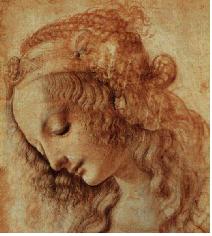
Sargent went about his work. It is not an effortless piece. Compare this portrait with one by Giovanni Boldini (1842-1931) above. Boldini could probably churn out his portraits by the dozen. Yet, in this work, there is an accidental feeling of the sitter emerging from the canvass as if she were the equivalent of a sculpture by Rodin coming out of the rock. This sketchiness and translucence in the media is not new at all, we can find it in the studies of the Grand Masters. There is something to be said about unfinished art. It emphasises the design elements. In the portrait of a woman by Leonardo da Vinci
we are led into the face through semi-circular movements, moving to the centre which is the closed eye. The love of the wavy hair signals to us the focus on the composition for its own sake. The sitter perhaps is not as important. Certainly, we find many artists who confronted with sometimes many hours of drawing and painting of a subject, straying into the abstract. In Cecil Beaton’s composition, the architectonics and patterns of the dress seems paramount. For Boldini it was the flourish of the stroke. John Singer Sargent also loves the material. He spent an inordinantly long time in the detail, so that we can sense the volume and touch of the materials. Another factor, is the sex factor. In many of the high society portraits of women we can see that an important visual locus are the neck line and shoulders, and some times the cleavage. We know that despite what we were taught in schools about Victorians being prudes, even the Queen was indulgent when it came to the naked form. Indeed the corset that constrictedand enslaved women, accentuated the bust and bottom, two of the predominant erotic topoi of male fantasies. Not surprisingly in the 21st century, many a high society woman or the equivalent (media celebrity) cannot wait to get their kit off and appear centrefold in Vanity Fair or even Playboy. The dichotomy between clothed and the unclothed of course is no better illustrated by Francisco de Goya (1746-1828) who painted la maja vestida (clothed) and la maja nuda (nude). These portraits may be of the Duchess of Alba.
The juxtaposition of these paintings have an uncanny resemblance to the cut and paste pornographic pictures of celebrities like Britney Spears. The heads are unsettling distinct from the bodies as if they were painted on afterwards. This is quite uncanny, the subject’s head is on another plane. Consider another portrait by Goya.
Monday, 14 June 2010
Broken Umbrellas and Broken Promises

The broken umbrella. What a common sight it is. Now I wonder how many of you have purchased an umbrella with the belief that when there is a spot of rain it will provide cover? Its original function was to shade the user from the Italian sun as a parasol. But later its other function took over. So. There is rain. I am sans umbrella. I make a hasty purchase in a well-known discount store (it could be any). Hey presto, I open it, and it covers me. So far so good. You already know where this is going I suspect. Since we seem to be in the Northern hemisphere's monsoon season, they call it, Summer, I needed the umbrella almost everytime I set foot outside. Now, it worked well when there was just rain, but when the wind picked up. Snap, and then the thing took on the look of a crow with a broken wing. Here I had to make a choice, the umbrella could with one of its ribs apart, still function, but it made me look more like a bum than usual. I continued to use it. Damn society that is what I say, I paid for it, didn't I, I will use it until its dying days - which occurred the very next day. The umbrella was no longer an umbrella. I thought more about what happened. You see what it boiled down to was that I got what I paid for. The umbrella would last only three days max. in windy weather. Who cares if the umbrella is cheap? Well I do. It is a rum way to do business. Why don't they warn the consumer? Call it a temp. umbrella. Maybe a crapella. These crapellae are manufactured in China. Now I do not think for one moment that China is to blame, because they manufacture quality goods too. It is the shops to blame. They do not give a damn. They do not test the goods. They know that if a customer comes back - they will happily replace the crapella. However, few come back, especially if it is raining. Few retain the receipts. Many are simply embarrassed. Who wants to bring a broken crapella back? A wet soggy detestable thing. Who would alternatively have the know-how of being able to repair it? Will it like the broken wing of a crow need a splint? A bandage? No. It is very difficult to fix it. I have tried, believe me, and the results put me further down the rungs of society -- the cheap bastard class. I think it needs a Ludwig Wittgenstein to engineer an umbrella (a crapella) that can stand all that Rear Admiral Beaufort can throw at it. I am thinking that a mint could be made by creating cheap rib attachers - flexi-rib kits can be bought from the Oblomov catalogue. It would be like the bicycle puncture kit. Simple. Really? Anyway, the thought of a fixed crapella has me smiling. Imagine the scene of some poor consumer being soaked after a crapella has decided on a new origami configuration - then here I come. Three snaps and the flexi-rib is in place. "I am singing in the rain...."
Tuesday, 8 June 2010
The novel and its designs.

Starting a novel is the easiest thing to do. Finishing is something quite else. Getting it published another matter still. Finally bringing the beloved reader to open the pages and READ. Now that needs a miracle these days, as everyone is so distracted. I was told, and I am repeating myself here, never write about writers. However, I find all those novels that have writers as focalizers or characters, to have that little extra attraction, like chili in tomato soup. I think the reason behind this attraction, is the feeling a writer's presence will provide an additional level. We become aware of the writing process, and can enjoy this in tandem with the story. The old metanarrative line. Of course, when the writer ODs on writing, then it takes you away from the READING. Those two Barthian elements, the writable and the readable are definitely palpable. When I start a novel ( I have started so many that it is like trying to jumpstart an old Vauxhall Viva in the midst of Winter), I generally have a design in mind. Maybe I become overwhelmed by the architecture - certainly in the case of New Cynics a novel that was a palimpseste on top of the original Cynics novel (one that is a work of genius) by Anatole Mariengoff. I started with a metaphor of Russia of the past as being like an unmade bed as to bridge the cynics of the NEP and my new cynics of the 1990's. The bed and its contours represented the geography of Russia, and then the focus shifted to the stains of lovemaking, to the visceral presence of the two principals, Vladimir and Olga. The novel also used the collage technique of John Dos Passos whose USA is still a hugely underestimated modernist masterpiece. Since the novel was set in Japan in the near future in the 1990's (at that time), the fillers were all futuristic, like a Japanese student who managed to get a car to run on Diet Coke.
At the centre of the novel was quite literally the erotics of writing. Vladimir the short-story writer was living off the earnings of Olga who worked in a club. In a section that follows the camera of the narrator, we follow him all the way to a sex act on stage. Not knowing that the act involves his wife, Olga. She shouts at him, just like in those many scenes where a home movie ends when a partner turns on the filmmaker and asks him what is he doing? We discover that Olga is working for the Mafia. She is owned. Vladimir tagged along. He is in a manner pimping his wife, and here the metaphor of pimping is critical of the writing process as appropriation or possession of people. The two living in Japan feel alienated. They want to escape. That is the engine of the novel. However, throughout, we get sections that include short stories and essays written by Vladimir. The stories are short and rewritings of folk tales. It was certainly not going to get from A to B quickly, yet the detective novel genre influenced the teleology. We have a character who follows them. He is the watcher. He has tattoos on his eye lids. Two knives that he keeps in his boots - called Mummy and Daddy. The novel was started. But it was beached by Life. Maybe the events in the interlude have over taken it, dated it. However, it is still there, in the consciousness. Olga and Vladimir will have their day. We shall see.
At the centre of the novel was quite literally the erotics of writing. Vladimir the short-story writer was living off the earnings of Olga who worked in a club. In a section that follows the camera of the narrator, we follow him all the way to a sex act on stage. Not knowing that the act involves his wife, Olga. She shouts at him, just like in those many scenes where a home movie ends when a partner turns on the filmmaker and asks him what is he doing? We discover that Olga is working for the Mafia. She is owned. Vladimir tagged along. He is in a manner pimping his wife, and here the metaphor of pimping is critical of the writing process as appropriation or possession of people. The two living in Japan feel alienated. They want to escape. That is the engine of the novel. However, throughout, we get sections that include short stories and essays written by Vladimir. The stories are short and rewritings of folk tales. It was certainly not going to get from A to B quickly, yet the detective novel genre influenced the teleology. We have a character who follows them. He is the watcher. He has tattoos on his eye lids. Two knives that he keeps in his boots - called Mummy and Daddy. The novel was started. But it was beached by Life. Maybe the events in the interlude have over taken it, dated it. However, it is still there, in the consciousness. Olga and Vladimir will have their day. We shall see.
Friday, 21 May 2010




Sunday, 16 May 2010
Heraclitus (Fragment 1)

Fragment 1
τοῦ δὲ λόγου τοῦδ ἐόντος ἀεὶ ἀξύνετοι γίνονται ἄνθρωποι καὶ πρόσθεν ἢ ἀκοῦσαι καὶ ἀκούσαντες τὸ πρῶτον· γινομένων γὰρ πάντων κατὰ τὸν λόγον τόνδε ἀπείροισιν ἐοίκασι πειρώμενοι καὶ ἐπέων καὶ ἔργων τοιούτων ὁκοίων ἐγὼ διηγεῦμαι κατὰ φύσιν διαιρέων ἕκαστον καὶ φράζων ὅκως ἔχει· τοὺς δὲ ἄλλους ἀνθρώπους λανθάνει ὁκόσα ἐγερθέντες ποιοῦσιν ὅκωσπερ ὁκόσα εὕδοντες ἐπιλανθάνονται
1. Although this Logos is eternally valid, yet men are unable to
understand it -- not only before hearing it, but even after they
have heard it for the first time. That is to say, although all things
come to pass in accordance with this Logos, men seem to be
quite without any experience of it - - - at least if they are judged
in the light of such words and deeds as I am here setting forth
according to its nature, and to specify how it behaves. Other
men, on the contrary, are as unaware of what they do when
awake as they are when asleep. (1) (from http://community.middlebury.edu/~harris/Philosophy/heraclitus.pdf
This fragment from the great presocratic philosopher Heraclitus gets one wondering about what exactly was the purpose of the whole work. In some translations we find differences:
according to its constitution
Other people, on the contrary
These differences can have dramatic consequences in the interpretation. When I first read this fragment I was awestruck by its metaphysical import, and its obvious connection to Christianity with its all important Logos. However, when I considered the context of the fragment, and the slant of its rhetoric, it seemed more and more as if Heraclitus was quoting someone else. These aphorisms, like Aesop's Fables, have an older original or source. The fragments are analogous to the analects of Confucius:
These guys were teachers. Teachers find their sources from earlier materials. The riddling and oppositions in Heraclitus also seem to have an Oriental equivalent in the koans:
From my perspective, the fragments of Heraclitus entertain one with a curiosity akin to looking at a shard of a ancient pot, or a bone of a dinosaur. There is this element of wow. These are the thoughts of someone who lived over two thousand years ago. Wow. They are a magnet for philosophers who like Martin Heidigger who excavated/exhumed the presocratic philosophies. One can build a city of ideas on these fragments. But are they really more than Ionian Greek "soundbites"? We have little to go on. A pity that the Library of Alexandria was destroyed. Perhaps we would have been able to read the whole work, and our impression would be different. Indeed, often like "baggy novels", philosophy that is interminably long presents us with formidable hurdle - few of us have the patience to wade through long philosophical texts. We like ideas to be presented in texts of ideally one hundred pages or so. Same with politics.
Saturday, 15 May 2010
Polluted Homes and Gardens.

Every householder and tenant lives in a toxic environment. Even if we discount the enormous number of bacteria and viruses to be found in the average household, some of which are harmful, our homes are full of chemicals that are harmful to our existence. True like rats and roaches we have built up an immunity to some, nevertheless they impair our development, our daily lives and shorten our lifespan. If we take for example a typical terrace property in England. If it is Victorian it is very likely to have been built upon contaminated land. During the height of the Industrial Revolution, the Victorians like others in booming countries, did not take adequate measures to tackle the toxins and chemicals. We find cases like this:
Everywhere in Britain the Victorians chucked out chemicals that are harmful. These shortened their lives, and they affect us still today. Of course this is nothing in comparison to the pollution in the 20th century. The mind boggles. New chemicals and compounds, and the proliferation of plastics, means that every single centimetre of UK soil has particles that are toxic. The same goes for the air and the water. If we add all this to the radioactive materials that have since the 1950's been added. Well. Of course we must include the power plants, cars, planes.... Imagine then when we have all this shit in our environment - what do we do? We buy more! Here is a basic rule. If you can smell it. Then that substance has entered your body. More enters through the skin and while you breath. Is it not about time we had assessment and analysis kits for every household - with cheap spectrometry sets so you can gauge just how bad your environment is. And like the geiger counter, would it not be useful to check products you buy and use for their toxicity?
Debt

We are told that Greece has a deficit of $405.7 billion. That is quite a sum. The State of California owes $34.6 billion. http://www.stateline.org/live/ViewPage.action?siteNodeId=136&languageId=1&contentId=15158
Wowee. Lots of money. Now interestingly the Mafia in Italy alone earns $90 billion. (in 2007)
I would reckon the the Worldwide earnings from crime would amount to a few trillion dollars. If the criminals earn a lot, it probably pales into insignificance compared to how much Government departments lose. For example, remember the unaccounted trillion dollars?http://articles.sfgate.com/2003-05-18/news/17491492_1_pentagon-gao-financial-accounting
Well add a few more trillions and one has an idea of how much is lost in military expenditure worldwide. But we have not even started to look at other losses and waste. Everyday, the individual throws money. We buy food and leave billions of tonnes of it. Look at every plate. How much is wasted. In the company, there is enormous waste. You just look at what is daily thrown away or retired before it has actually worn out. Trillions of dollars is spent on meaningless crap.
We spend much on needless and dangerous packaging:
If we were to add up the all the waste and losses incurred each year, we could probably manage to look after our planet for 100 years! Let's turn to Greece now. A convenient scapegoat as they have, well their government, cooked the books. Why did they do that? Oh to further their political goals. Yet, during this period, while they and other (lower)developed and developing nations were also cooking their books - they had ideological goals. They were putting a huge amount into welfare and actually caring for their people -even if they creamed a lot off themselves. This is totally different from those traders who were capitalising on poor households so as to make trillions. They did not give a f**k about those people, and still don't. Now, the countries who played and controlled the monopoly board, have decided that the banker must always win - so they are taking it out on soft targets. Health, education, and the like. Not the military! They are also, those countries that created the mess, taking a high moral ground against those who had weak infrastructures in the first place. So the US which has the greatest national debt on the planet tells Greece to change its behaviour!!! http://en.wikipedia.org/wiki/United_States_public_debt
Now that is what they say in England, pretty rich of them to say that.
Monday, 10 May 2010
How a Poem is Made.


This short essay has been inspired by C. Day Lewis's advice in his Poetry For You (1944). I will take you through it, as if it were a procedure for something, hopefully in this case pleasant. We start with nature. I would like to capitalise Nature, but I am afraid she/he is not really around these days, and it is this thought that provides the argument or "spin" of the poem. When for example we read nature poetry of the Renaissance - Nature was wild. You could for example find bears and wolves on the continent roaming the woods, though in Britain they had been extinct since 10th century (for bears) and 16th century (for wolves in England). Though they were for the most part wiped out in England by the time of the Elizabethans, they, as representatives of wild Nature were still vivid in the minds, and a reality. Now, unless you live in the States or parts of Northern and Eastern Europe, they are something you see in zoos, in circus shows or on television.
So the bear, with heavy paw, through the woodland
of our history, baits us with her presence, as the wolves
in city and football, howl like Jack Nicholson in Shining,
Here we start with the bear, then as C.Day Lewis puts it, play with double or triple-barrelled comparisons. The reversal of "bait" as in bear-baiting. The reference to Wolverhampton and then the less obvious reference to the movie Wolf. Now we have the first few lines to work with. They are prose-like, but natural rhymes and associations come to mind in the acoustic patterning, we have heavy paw / this yields early thaw, and football, gives us footfall. We will use this to render and construct the poem, as the argument unfolds. After a hiatus, a trip to the city and back, I got to thinking about the Edenic conception of nature and how the birds and beasts
are now in the back garden in the UK. I also saw in the station a Danish magazine called "Big Game" which enraged me. The ladder is a reference to Aristotle's ladder. Entrained refers to the growing of vines and the training of zoo animals to present "wildness".
The birds and beasts of cigarette cards are from Eden
now inhabitants of the suburban back garden
Where in the midst of foreign plants and flowers
they make their home, their they past their hours
Domesticated by bulldozers and the pollution
Feeling safe and secure, the fox, badger and hedgehog
As the really wild growl and rage in presentation
Entrained like vine to demonstrate the Nature
Of man's good husbandry, the absent fathers
Leave tiny chicks and ducklings to the maw
of machinery, crushing the living daylights
As the early thaw of the wild, bleeds into captivity
The footfall of freedom only for the baby-headed
Some try to climb the ladder through appetites
changing, as fatty life, like porkers, decline
But then Africa and Russia leads the proclivity
For hunting and killing, wildebeest and zebras
Big game for big boys with small shoe size
On the sly, like collateral dolplins, the leopard
and big cats, for a few thousand, are extras.
A fix of Alexander Trocchi: Cain's Book (1960)
There will be readers (if there are any) who know of Trocchi's writings through the fairly recent movie "Young Adam" (2003) directed by David Mackenzie and starring A class actors Ewan McGregor a and Tilda Swinton. I came across his writings through a reference in a book, and the particular title in John Calder's biography, Pursuit: http://www.oneworldclassics.com/pursuit-p-305-book.html
At first glance, the book as autobiographical novel Cain's Book (1960) with its wonderful picture of a scow, is the usual tough-guy-delinquent-junkie-existentialist novel, the Jean Genet, Henry Miller, William Burroughs type. It has a quote from Sade for God's sake with MAINLINES running from top to bottom. But as soon as you cross that threshol, you find out that Trocchi belongs also to the naturalist school, the Jack London, Theodor Dreiser, James T. Farrell (Studs Lonigan) school.
My scow is tied up in the canal at Flushing, N.Y., alongside the landing stage of the Mac Asphalt and Construction Corporation. It is now just after five in the afternoon. Today at this time it is still afternoon, and the sun, striking the cinderblocks of the main building of the works, has turned them pink. The motor cranes and the decks of the other scows tied up round about are deserted.
Half an hour ago I gave myself a fix. (page. 9.)
Pardon, the expression, but after this entree, I was hooked. We really get inside the hero's head. The intertextuality and self-reflexivity of this novel, where he often refers to the notes that went into the construction of the book, and refers to the novel itself throughout, breaks that golden rule - do not write about writing. Fuck that. I love reading about how writers became writers and the process. Next chapter, we have Cocteau in French, more details about what he was doing, i.e. working on the scow. A little piece on marijuana. Then later the description of two junkies, Tom, Fay and Tom's dog. He doesn't mince words in his description. The life of a junkie that has gone on beyond the possibility of "retreat", is really an end-game of self-destruction, sinking lower and lower - to become society's untouchable. Sad. Just think in Copenhagen they are going to have fix cabins that will have videos. The hero in the novel, at this point is able to keep the habit under control - therefore preach and be metaphysical. The kind of S.T. Coleridge approach. We as readers are fix-tourists.
At first glance, the book as autobiographical novel Cain's Book (1960) with its wonderful picture of a scow, is the usual tough-guy-delinquent-junkie-existentialist novel, the Jean Genet, Henry Miller, William Burroughs type. It has a quote from Sade for God's sake with MAINLINES running from top to bottom. But as soon as you cross that threshol, you find out that Trocchi belongs also to the naturalist school, the Jack London, Theodor Dreiser, James T. Farrell (Studs Lonigan) school.
My scow is tied up in the canal at Flushing, N.Y., alongside the landing stage of the Mac Asphalt and Construction Corporation. It is now just after five in the afternoon. Today at this time it is still afternoon, and the sun, striking the cinderblocks of the main building of the works, has turned them pink. The motor cranes and the decks of the other scows tied up round about are deserted.
Half an hour ago I gave myself a fix. (page. 9.)
Pardon, the expression, but after this entree, I was hooked. We really get inside the hero's head. The intertextuality and self-reflexivity of this novel, where he often refers to the notes that went into the construction of the book, and refers to the novel itself throughout, breaks that golden rule - do not write about writing. Fuck that. I love reading about how writers became writers and the process. Next chapter, we have Cocteau in French, more details about what he was doing, i.e. working on the scow. A little piece on marijuana. Then later the description of two junkies, Tom, Fay and Tom's dog. He doesn't mince words in his description. The life of a junkie that has gone on beyond the possibility of "retreat", is really an end-game of self-destruction, sinking lower and lower - to become society's untouchable. Sad. Just think in Copenhagen they are going to have fix cabins that will have videos. The hero in the novel, at this point is able to keep the habit under control - therefore preach and be metaphysical. The kind of S.T. Coleridge approach. We as readers are fix-tourists.
Poets are Daft

A title like that is bound to get the poets rushing to the blog and all steamed-up ready to knock the stuffing out of the essay. Of course poets are not daft. Some of them maybe. But not all of them. The title or rather topic comes from a lovely little book by C. Day Lewis Poetry For You Basil Blackwell: Oxford. (1944). The intended readership was boys and girls. Boy, did CDL have fun with this book. He was really updating Sir Philip Sidney's Apology For Poetry (1597 around there). People in 1944, during the war and before, were not really appreciative of the poet's worth. You'd get these Colonel types stating with the authority of being in the Boer War, that poetry was plain daft and unmanly (memories of being buggered in public school) and others like Ernest Vanewright, an accountant at Grime & Grime would urge them to get a job, and perhaps a haircut. Then there will be the man sat in an armchair looking all Home University like, smoking a pipe, and arguing in a thick Lancashire accent, "No you can't, young man get anywhere in life by writing poetry." Then, and this is not in the order of CDL, you'd have the stockbroker dressed in pin stripes on the train platform at Barking, letting his Times slip down a crack or two, "Look you can't make money writing poetry." CDL uses these common truisms (a tautology but hey you need to double up sometimes, to supersize a point), to argue the opposite, so the little ones, those little mites, will move on from the Famous Five and tackle poetry. Not the stuff of the Victorians. Not the stuff you learnt by heart and could fart in your sleep. No, poetry you actually love. He starts with the assumption "Poetry is Daft". Now, I think he got to use a trope of that period, his poetic knickers in a twist. What he argues, in a Richard Dawkins manner, is that poets do think differently, but he does it...crazily.
Poetry who say poetry is daft are usually frightened of life, frightened of their own feelings and the mysterious of the world. (p. 1)
How true. You bastards who think poets are crazy - you need therapy! You need...poetry:
If you're afraid of having your feelings stirred in the way poetry can stir them, if don't want to see more of the world than meets the eye, if you're afraid to see beyond your own nose, then you certainly avoid poetry as you would a lunatic. (ibid, 1-2)
Not very convincing? Stirring. Like those stirrings under the bedsheets? Poets see things. Hear things perhaps. Regular Joan of the Arcs. Then CDL elaborates and makes the connection - poets and prophets. Jesus. The little kiddies are shitting themselves. Are poets really prophets? They have the "spirit breathed into" themselves. But hey,
But we must no assume, because of this, that poets are crazy.
Peter and Jane are trembling now. Was Mummy and Daddy right?
After all, you don't have to be a poet to feel "enthusiasm": each of you has moments when he feels a strange unaccountable excitement welling up inside him, a kind of "inspiration"; but you don't go whizzing off to the doctor and ask him whether he doesn't think you ought to be put in a lunatic asylum. Some poets do go mad, of course -- William Blake, William Cowper, John Clare, Christopher Smart did, and they were all fine poets. (ibid).
So Doctor, I have these episodes, when I look at a tree, and...
Yes continue Sonny.
I think it is...
Yes let your feelings out
Well Doctor I think that tree is like
Come on Sonny let it come out
Like a... banana
A what?
Doctor I see all these bananas.
Really Sonny, I thought you were going to be more imaginative than this displaced phallus simile
But Doctor...am I a ...poet
Rest assured you are not one of those, perhaps you might be a Music Hall comedian.
Oh my God Doctor - am I crazy
No Sonny you will make a lot of money...
For some daft reason, CDL has got into his head - it is only boys that want to be poets.
Sunday, 9 May 2010
Reading Kenneth Rexroth's "Bird in the Bush" (1959)

Some writers are bold enough to tell you how it is. Kenneth Rexroth (1905-1982) was one of those. He was experienced, went to the school of hard knocks, but like Nelson Algren, was urbane and sophisticated in his responses to the environment. He asked questions before sticking it on you. No, he had from an early period in his life as an orphan been a voracious reader of classics, positively hoovering them up by the set. Yet, in this instance, he was not a guy like Aldous Huxley who took volumes of the Encyclopedia Britannica around with him in his suitcase - no the knowledge was palpable and streetwise. He was hip. However, like the hard-boiled Algren, Rexroth was a romantic of sorts. Always courting the ladies. All of them would leave him, bar one, who married him in the end as it was convenient. Rexroth had his soft and spiritual side - he was though in his way just as misogynistic as D.H. Lawrence. His rather phony idea of the sanctity of marriage is seen in his description of the epiphanic moment in Lawrence's writings:
Reality streams through the body of Frieda, through every place she steps, valued absolutely, totally, beyond time and place, in the minute particular. The swinging of her breasts as she stoops in the bath, the roses, the deer, the harvesters, the hissing of the glacier water in the steep river--everything stands out lit by a light not of this earth and at the same time completely of this earth, the light of the Holy Sacrament of Marriage, whose source is the wedded body of the bride. from "Poetry, Regeneration, and D.H. Lawrence" (p. 189) in Bird in the Bush (1959.
I might get caught up in this erotic-mysticism if I was an adolescent kid just graduating from masturbating and looking or hankering towards something more meaningful. Sex is situated in the natural - but it is for Rexroth and Lawrence - one-way sex, not the I and Thou dialogue. Yet, Rexroth does catch the drift of the complexity of Lawrence, and in the next descriptive take on the minor prophet, echoes Lawrence's gift for communing with nature (probably his forte):
The accuracy of Lawrence's observation haunts the mind permanently. I have never stood beside a glacier river, at just that relative elevation, and just that pitch, with just that depth of swift water moving over a cobbled bed, without hearing again the specific hiss of Lawrence's Isar. These poems may not be subliminated (whatever Y.M.C.A. evasion that may refer to), but they are certainly pure and eternal. (ibid)
I like the swipe at the Christian prudery. Our Ken knew how to do those literary rabbit punches, hurt them good. He is also, as a poet, one who as a critic, which he categorically refuses to be in this collection, very good at quickly cutting to what matters in Lawrence. While some people have difficulty understanding the acoustics and metrical system of Lawrence - Rexroth, brilliantly captures it:
I think Lawrence was simply very sensitive to quantity and to the cadenced pulses of verse. In the back of his head was a stock of sundry standard English verse patterns. He started humming a poem, hu hu hum, hum hum, hu hu hum hu, adjusted it as best might be to the remembered accentual patterns, and let it go at that. (ibid., p.179)
As a poet, Rexroth excelled at finding out what was going on in other poet's works. In his other capacity as a translator, he had prejudices. He preferred the Chinese classics to the Japanese classics. Perhaps it was the bawdiness - like ranging Chaucer against Dante? I do not accept this approach. I can read the Chinese classic, The Monkey by Wu Cheng'en (translated by Arthur Waley) and enjoy its satire, and then lay it to one side and pick up the exquisite account of the Shining Price in the Tales of the Genji by Murasaki Shikabu ( translated by Edward Seidensticker). Nevertheless, one can really enjoy Rexroth's riff on Chinese literature and why he likes it. It is addictive. You really do want to go to the university library or onto Amazon/Abebooks and get a hold of the The Dream of the Red Chamber or The Water Margin . Yes, it is true, if you read these kinds of works, just like the sets of the classics you submerge yourself into another world, more than any role play game can do. That's the point of these essays. Enthusiasm. Eventually, despite wanting to lose your temper with Rexroth when he crudely deconstructs, but honestly, your taste for a writer or even a belief, you do want to thank him, because he got you engaged rather than passively sucking up literature - like a robot vacuum cleaner. In an essay on Martin Buber, "The Hasidism of Martin Buber", Rexroth like Edmund Wilson on the Dead Sea Scrolls, again gets you hooked on a different perspective to religion - not the Sunday school type. I suppose, Buber is in that group of writers and thinkers we (especially guys) like to incorporate into our worldview, a kind of intellectual brand statement. Today I am wearing Franz Kafka briefs, and Фёдор Михайлович Достоевский patent shoes, Martin Buber aftershave, a Jean-Paul Sartre white shirt. We are caddis-flies, really. Now, in the midst of reading the essay, and getting dreadfully lost in the Gnosticism, I spotted a typo. Thank (no)God/s for typos. It was the Idealist philosopher, John McTaggart Ellis McTaggart (3 September 1866 – 18 January, 1925). He had become a McTeggart. I do not think the two would have got along very well. McTag changed his name to inherit, and McTeg might imply a snipe at this name changing. Though it does in the ordinary language sort of way open up the possibility of discussing the reality of names. And (never start with and - but I do to flout convention), I once had a book from McTag's personal library. Not much kudos there. You cannot walk into a cafteria and say, look I got a book that once belonged to a British idealist philosopher. They would think you were completely crackers or daft - the subject of another short essay.
Tuesday, 4 May 2010
Anti-People Design

This park bench in leafy Montreal seems very comfortable, however, it is not the most comfortable bench to sleep on, since it has some curves that resist rather than accept the body. But no doubt you can sleep on it as that guy is doing. In the past year the Kings' Garden (Kongens Have) in Odense Denmark, has removed its wooden benches and replaced them with concrete cylindrical benches. These are fast-butt design. I mean you can't sit on a concrete surface for long without getting either cold or suffering from butt friction. These concrete benches also reflect a trend against nature. They are cheap and easy to maintain, but unsightly and not at all comfortable. So why on earth did they decide to litter the park with these benches? Well, the primary function was probably anti-people. They did not want homeless people, drunks, junkies or for that matter anyone, staying too long in the park as they like the trees that used to adorn the park, pose a threat to the ordinary citizen on a stroll or going to the station. Of course, nobody wants to be mugged or raped, nor do many people want to be confronted by people begging, or being obnoxious, However, some of us, in a meditative mood would like to take the time to sit and read or just look at the trees. These pleasures, of the solitary bench sitter, are gone. You now are exposed to all and sundry, and unable to relax at all - you cannot sit and rest your back - if you stay too long you will have to visit a chiropractor. So what is all this about, this anti-people design? It is targetting mostly those who need help. The unfortunates, a class which most of us avoid. However, this anti-people design of street furniture which includes toilets that are not free, sprinklers on lawns, spikes on fences, concrete defences, alarms, and generally anything that gets you to leave a space quickly - is also connected to anti-crime and anti-terrorism design. You can't throw away rubbish in some places, you can't sleep in many places, and more and more you simply can't enter a zone unless you have a credit card or belong there. Those apartheid housing estates now have armed guards to protect the American Dream of Disney values. Architects are now instructed to design buildings which can withstand explosives and a boeing jet crashing into it. Maybe the intelligent buildings of the future will class you through instant profiling. Those of a certain configuration will be denied access. What a ridiculously uncaring world we are creating, one that destroys nature because it harbours potential criminals, one that replaces natural coloured and comfortable seats with concrete blocks, so that one can sit for five minutes then move on. It is as if a neutron bomb was dropped on design.
Monday, 3 May 2010
Crime in America

As we watch the grilling take place in the recent hearings of the Permanent Subcommittee on Investigations, one is reminded of the infamous Kefauver hearings of the early 1950's. Except in the case of the latter it was organized criminals on trial and not as hear criminal organizers - to paraphrase Kefauver. Both of these hearings revolve around communication and knowledge. The mobsters were tapping into the news cables and using information about racing results for illegal ends. They set up their own wire services to steal the news. It was all to do with results, (like insider trading). Of course as Estes Kefauver records in his "Crime in America" (1952) based on the hearings, the mobsters were so good that they could repair a connection after the wires were down in fifteen minutes, whereas as a whole army took three hours to get normal transmission then vital for the war effort. They were really organized. They bought people. People who they did not buy, they iced. Now what does this have to do with all these bankers and traders? They aren't in cosca, are they? No certainly not. But they do tend to defend their practices with the temerity of the mafia. When they are grilled. They start damage limitation exercises. Seek ways of offsetting the cost. Maybe they could blow it all away with a tax fiddle? But, you may argue, they are thugs. They are just doing business - one that enriched the US by trillions. Yes, however, the key products they created, the products of intellectual masturbation, the toxic debt repackaging of a Chinese mathematician, were just as insidious as narcotics. Everyone wanted them. Buy, buy. Those in the know, knew it was shit like the tulips of Holland or the real estate in Florida. They knew it was wrong and sold it on. Knowing full well that they would not have to pay - they would just take their commision. Even the mafia mobsters as cold-blooded as they were, would not rob their grandmothers - well some of them maybe. These people using every form of mathematical manipulation available, did a monumental shell game on billions of people. They did it on a scale that makes the mafia's operations look like a corner store robbery. Do they pay for it? Of course not, because like in the Kefauver Hearings, the reach of corruption is so great that if they were put on trial, the whole government at all levels would collapse, because so many politicians and those in the administration were made fat cats from these financiers. Then there is the Donald Trump law - if your billionaire goes down - don't worry - sooner or later he'll be back up again and the glorious system will be spinning its wheels again. What a pity there are no tough guys around to follow through, and kick the ass of what is a very corrupt system - which destroyed the manufacturing base of the United States, robbed people of their dream homes and caused collateral damage world-wide so that the poorer are poorer. The rich. Well they just dust off the insults off their Armani suits and get back on gaining money for themselves - and losing the money of others.
Sunday, 2 May 2010
A Page from a Hard-Boiled Novel

There used to be a campaign in Britain to sell eggs, it had a slogan "Go to work on an egg". Now some of you like your eggs runny, and I am particularly fond of the yolky eggs that one can dip a soldier into (a soldier being a thin strip of toast with butter on it), but sometimes I'll have it hard-boiled. I guess if you were to sell the eggs today, you could have a mug shot of Nelson Algren, the quintessential hard-boiled writer from Chicago. Now Nelson was who the existentialists called in when there was a dispute over the meaning of life. Hard. Oh yes hard, but sweet on Simone de B. As you sit at your breakfast table taking in the latest news on the radio or tv or on the screen of your computer, you might take a break from the hard-core reality of a majorly fucked up world, and read some fiction. Nothing to take your mind off crime than reading crime fiction, or as they put it in the 1940's, a crime mystery. I have at my side "a genuine pock book mystery" by Raymond Chandler. It has a picture of a bald guy, and a hand lifting off a wig (toupee). Someone has kindly stuck what looks like a screwdriver (actually an icepick) into his neck. In the top left hand corner, the Pocketbook kangeroo, bless her heart seems all too cheerful about the guy's demise. For those of the 1970's, that red slip with a reference to Bay City tucked under the wig, might suggest the guy was killed for his lack of taste in youth bands. Since there is no tartan scarf in view, and the book was originally published in 1949, we can be assured that this cultural relativism can be put to rest immediately. As we breath a sigh of relief, we can move on to the title, "The Little Síster". Is that some clue or what? Well maybe. Maybe not. The slip or receipt seems to be one. The wig/toupee another. For darn sake are they spoiling everything? Then just to make sure you haven't hatched out your own scenario, they give you a cast of characters. If you go through those alone you might hazard (I like this word) a guess at who or what did what. I like the little bios, for instance:
G.W. Hicks
A sensitive type who doesn't like to be seen without his toupee
Mr Flack
House detective at Hotel Van Nuys; his salary is small and his cupidity great..
The guys or gals writing this stuff really soaked up the hard-boiled style! But they are amateurs. Wait until the supremo starts . We start with the door of the private dick. This is a wonderful entry, full of Chandler's powers of description and laconicism.
The pebbled glass door panel is lettered in flaked black pain: "Philip Marlowe...Investigations." it is a reasonably shabby door at the end of a reasonably shabby corridor in the sort of building that was new about the year the all-tile bathroom became the basis of civilization. The door is locked, but next to it is another door with the same legend which is not locked. Come on in- there's nobody in here, but me and a big bluebottle fly. But not if your're from Manhattan, Kansas. p. 1
Look how much Chandler packs into that paragraph. Firstly, he introduces the hero and his occupation, gives an idea of the layout and environs of the office, tells you something about the character's cynicism. Provides you with a brilliant metaphor of what the middle-class strive for - the American Dream ... "the all-tile bathroom". Establishes the style and tone. It is hard and informal. "in the sort of". Sets up an original duet with the hero and a bluebottle fly. Then anticipates what's going to happen next with that geographical oxymoron, "Manhattan, Kansas" What does Genette call this? Analeptic whatever. Now we are still on page one. In the next paragraph Chandler describes the season. Oh yes the season. It is not one of those laborious descriptions with layers upon layers of adjectives. It is cynical to hell:
It was one of those clear, bright summer mornings we get in the early spring in California before the high fog sets in. The rain are over. The hills are still green and in the valley across the Hollywood hills you can see snow on the high mountains.
Economical, terse, but you get the picture. Next he follows this up by hard-boilerizing (what a ridiculous neologism :-))
The fur stores are advertising their annual sales. The call houses that specialize in sixteen-year-old virgins are doing a land-office business. And in Beverly Hills the jacaranda trees are beginning to bloom.
Look at how he plays with the constrast between the glamour of HOLLYWOOD and the sleaze associated with it. How he deftly moves from the call houses to the natural description of Californian spring. The purple-blue bloom of the jacaranda tells you this is a warm almost tropical place. So, after taking in the local exotica, Chandler gets straight down to business. Marlowe has to deal with that pesky "bugger" (as President Obama would call it) the bluebottle.
By the way, from my pov, I find the bluebottle and the greenbottle flies to be absolutely disgusting - give me a housefly or better still a greenfly any day. Back to the plot.
I had been stalking the bluebottle fly for five minutes, waiting for him to sit down. He didn't want to sit down. He just wanted to do wing-overs and sing the prologue to Pagliacci. I had the fly swatter poised in midair and I was all set. There was a patch of bright sunlight on the corner of the desk and I knew that sooner or later that was where he was going to light. But when he did, I,
end of page one.
He has you on the edge of your seat,what will happen next? And that brilliant cultural association - Ruggero Leoncavallo's Pagliacci (1892). Listen for yourself:
Sublime.
Wednesday, 28 April 2010
Heavy Reading

Heavy. That is an adjective I have heard many a time to refer to a book. We are not talking weight - but often it is also a factor. Who wants to lug around a book that weighs the same as a bag of potatoes? That kind of heaviness has prevented me from borrowing books. The prospect of carrying a particularly heavy book on robotics around nearly stopped me - but fortunately the bus route allowed for a relatively easy transportation. In the future I'd have my robot James carry it for me. It is one argument for electronic books. Just one. I prefer however the tactile quality of touching a book, the aroma of musty and new books alike - probably not good for you at all. The heaviness I am talking about here is the other type. Literary heaviness. The mind gob-stoppers like the modernists Proust, Musil, Nabokov, Joyce and their spawn. There was an exhibition in the Freud museum in Vienna where they had books that people were given but couldn't finish - many were from the modernist canon. You can't read these books and watch television - nor for that matter can you listen to Alexander Scriabin's Piano Sonata No. 1 in F minor and watch Paris Hilton and Friends. I tried and failed. It is either Paris or Alexander. Try the following. Reading Aidan Higgins' Balcony of Europe and listening to music. You can't do it. But you could read a John Grisham novel and stand one leg, watch a rare recording of Maria Callas and still know who did it. I found Higgins' novel, the first part to be very Iroishy and delightful in a Flann O'Brien way. The bulk however is rich. Every page is encyclopaedic in reference - we learn a lot from how a hedgehog makes love, to the slang of someone from x place. It is very rich. You must pace yourself like a box of expensive and filling chocolates. It has the catholicity of the Baron Corvo and the absurdity of Sam Beckett. If it were a dog it would piss on your trouser leg and then adopt the pose of a martyr. There is sex and booze there too. John Calder tells us in his autobiography that Aidan was a boozer. Maybe you need a drink to relax you while you are on board the Higgens' book.
Tuesday, 27 April 2010
Birds

Birds of a feather. I think if I were to choose a Disney character - it would have to be Donald Duck. I could quite easily mimic his face, but not his voice. I always preferred him over Bugs Bunny and Daffy Duck, both of whom though having edge, had a certain nastiness to them. Donald Duck though always scheming and with a positive ducky glee in his eyes when his plots work, remained a comic creature with a heart as seen in his romancing and in his attitude to his nephews. The Warner Brothers' characters lack real empathy. Having said this, I always found Mickey Mouse to be mawkish. Now that is a lovely word. Mawkish: from the word maggot perhaps, So, yes Donald Duck enters that list of birds in my private remembered aviary. Another bird which I remember with fondness is the white-bellied sea eagle of Singapore. Quite a mouthful, its scientific name sounds like bad breath: Haliaeetus leucogaster. The reason why this bird is important, is because it appeared on a Singapore postage stamp. I link this to geese. Again for the same reason. My father had decided I was to collect bird and space stamps, and from a Sikh selling stamps on Orchard Road got a bundle of Chinese stamps three of which were actually Japanese :
http://cgi.ebay.co.uk/Japan-1949-Hiroshige-geese-sheet-5-MNH-FVF-defect-/180477206282
They were thrown out by accident when my mum was housecleaning. I was a tad upset. But then on the other hand I am not the tidiest of people. Years later I was to go to Japan and I became interested in Japanese prints. Thanks to those geese I believe. Still in Singapore, I lived with my family in Jalan Bankett near a stream and a mini jungle. I daily saw so many of the birds listed here:
http://cgi.ebay.co.uk/Japan-1949-Hiroshige-geese-sheet-5-MNH-FVF-defect-/180477206282
They were thrown out by accident when my mum was housecleaning. I was a tad upset. But then on the other hand I am not the tidiest of people. Years later I was to go to Japan and I became interested in Japanese prints. Thanks to those geese I believe. Still in Singapore, I lived with my family in Jalan Bankett near a stream and a mini jungle. I daily saw so many of the birds listed here:
Now I cannot really make my mind up if I saw a purple swamphen (common then) or the much rarer jacana visitor. I think it was the latter. Both are beautiful birds. As for the ubiquitous mynah bird, the talking bird of the Far East, I was told a story by an American officer (one with a lots of medals) on leave during the Vietnam war. His story merged with his recounting the meetings with Charlies. I thought he was quite something at the time - and I also liked John Wayne in the Green Berets. How times change!! Another common bird was the beautiful golden oriole, http://en.wikipedia.org/wiki/Golden_oriole . It seems like a bird dreamt up by James Elroy Flecker. A bird that causes a titter among Americans, it the titmice. The blue tit is the little bird of W.C. Fields' heart , his chickadee in Americano. My French master a keen bird watcher told me as I walked with him in a park near Alnwick castle, that the blue tit call sounded like a bicycle pump. Now maybe I am making it up, but one outing some boys took a bicycle pump with them. A friend of mine kept pigeons. They were his love. Darwin loved them too. My mother however was not so keen on them. I had Joey the guinea pig in lieu. I think I actually liked Joey more. I find the little pigeons to be the ugliest things around - even invertebrates look prettier. But pigeon fanciers love them. I preferred sea birds. The kittiwakes that swooped and circled the cliffs of Howick. How many times have I used them in imagery. Those doll's eyes. The plumage.
Thursday, 22 April 2010
Nosey Caricatura

Having a rather prominent nose, I have been throughout my life been alerted to its comic potential - a fact which has been seized upon by bullies and friends alike. My brothers, not so well endowed in this department, would make ducking motions after calling my name. At school, those of a Pythagorian persuasion were wont to call me Terry Triangle which also fitted my pigeon or barrel chest (the late Robert Mitchum and lots of others sported). I think it hurt me. Children, and even work colleagues, love to tease and given any purchase on a person, such as a minor defect will be emboldened to enlarge, extend, until it takes upon such proportions until you think that person is just a walking spot or nose. Of course it would seem that public figures with power or fame, are sitting ducks for this wilful misperception. It can hurt, and of course it is also a lot of fun, to be handled like a firework, very responsibly, lest it blow up in your face. I can now celebrate my nose, and can anticipate jokes regarding my schnozzle at the blink of an eyelid, like the more celebrated schnozzlee, Cyrano. Large, pointed, snubbly, flat, whatever the shape, noses are more than olfactory organs. Mine was used as a prototype for concorde design. Boom boom. I am in no need of a remote control because I can use my nose. Boom boom. Yet, if one discusses noses of people of different ethnic backgrounds, then it is a different matter, it is ideological. Difficult then, for the caricaturists of the British prime minister Benjamin Disraeli, because from their perspective, his nose defined him as different and had obvious comic possibilities. Much easier with Gladstone whose nose, though not semitic, was an object of ridicule through extension. It would seem that though caricatures can be used to support politicians or as fun souveneirs from Paris, they can hurt individuals greatly and should be seen as a visual assault in the case of those who belong to classes of people who are without power such as ordinary folk and minorities. The classical example of bad caricature is the one that offended the Islamic community. It was one of their prophet. Firstly, it would seem that Gods and Prophets are fit subjects for caricature, because they are all powerful. However, while that may be true, the object of the caricature was not primarily the prophet, but his believers, and they in Denmark belonged to a minority class who did not have the real power to either smile and accept, because they did not share the same values, nor have the power to defend themselves. The caricaturist working for a fairly right wing newspaper felt that his intended readership, the ones who would titter over his drawing, would share his beliefs regarding the minority that had been ghettoised in Denmark and had been from the newspaper’s pov, radicalised by extreme Islam. The local moslems could not themselves defend themselves, thus it became a matter of concern for the Moslem world. Many in Denmark in their defence of the caricaturist say that freedom of expression is primary, and that the moslems should learn to laugh at themselves. After all Jesus and Christianity had been satirised for eons. However, this is arguing from a position of strength and shared beliefs – to make and extend jokes about the Danish royal family is tolerated, but there is a line. You can only go so far in attacking a sovereign leader. It would seem that common sense can dictate how one represents people, in fairness, one should not really mock those who cannot defend themselves, even if it is the targetting of a prophet – there is collateral damage that harms people locally.
Monday, 19 April 2010
A Fresh Page

Fresh. A fresh page. "Turn over a new leaf" as they say. I did. Literally. I started a short piece in the notebook; starting with a kaleidoscope of images and topics, all colliding into each other, then settling down into a pattern, finally forming a topic. Degas og Orleans. To the non-Danish that "og" would be pronounced like the "og" in Caveman argot, in the speak of Anthony Burgess in 2001 in front of the black obelisk, "Og!" Maybe even in the suave but chilling curse of Alex in A Clockwork Orange. But relax, "og" just means and in Danish. It is the title of a catalogue-book that I picked up for a snip at 10 Danish kroner. There was in the 1990's an exhibition in which the New Orleans Museum of Art cooperated with Ordrupgaard Gallery to put on a show of Degas's art connected with New Orleans. What attracted to me the book was the cover pastel. The book was lying on top of an out of date atlas and other books of irrelevancies. Of course there might be a sad soul who collects those - I don't. The cover pastel is of a woman (Matilde Mussen in the catalogue) but later I discovered that it is her sister Estelle Mussen who married René de Gas, the artist's brother. The pastel is in the Ordrupgaard Gallery. She was pregnant at the time, and perhaps this accounts for the colours in the face, and the expansive dress. Her skin tones and the grey-blue eyes are echoed in the dress and the indefinite vista to her left. A light orange tinges her lips which in cooperation with a salmon pink are reflected in the trimming of her top. She holds a fan that is a vague slab. The lighting in the pastel suggests heat one that radiates and irradicates the visual definition of the balcony. There are features that I dwell on when I look at the pastel - like the hair. She has a fringe that points up like a Gothic arch, and the eye brows plus her nose area seem to be in simpatico with the arches in the railing. The mass and airiness of the dress is Dega's forte. I remember seeing something similar in the 1980's work of Francesco Clemente, the Italian neoexpressionist. The sketchiness of the pastel links the work . Of course in Degas we are confronted with impressionism - the art of suggestion. But the modelling in the face is not adventurous. You find that face in the Renaissance. The more abstract forms are found in the accompanying sketches that led to this work. In one of the drawings, we see that Degas is no Raphael - Estelle has a masculine face, the shading and neck, looks as if they are coming towards rather than receding. The arm does not look as if it belongs to the body. A metaphysical paradox which you find in many drawings, where the artist fails to integrate and harmonise the parts. Yet, this is a mistake, because what Degas is doing, is sorting out the planes or levels of the art, working in different media to understand the colours, etc. Funnily enough, those experiments, like the rough models of sculptors of the period, anticipate the works of the Fauvists like Henri Matisse by thirty or more years.
Saturday, 17 April 2010
Having a Cup of Coffee

Last night I saw the wonderful series of Sherlock Holmes starring the late Jeremy Brett. The particular tale was the one about the red headed league which was a "red herring" for the evil scheme of Professor Moriaty to rob a bank of French gold. What struck me was the fact Holmes said it was a "three pipes" case. I am sat in a railway cafe and this short essay or prose piece, is a one cup of coffee piece. I will write it up later. At the time of writing I am using a cheap 3 kr notebook and of all things a red felt tip pen. It looks as if everything is incorrect - I mean one maths teacher of mine used to use red and scrawl all over my geometry. If it was wrong. She tore the page out - like those torturers ripping out innards in Singapore's Tiger Balm Gardens! I do recollect, probably incorrectly, that Balzac was a sixty cups of coffee a day man - it killed him. One strong espresso gets me jittery. However, one coffee in the morning usually wakes me up. Was it King James I or a Sultan who banned coffee? These monarchs! They suddenly take a dislike to something and then they ban it. Now of course if I were a supreme sovereign ruler, I'd ban lemon curd. Jars of that toxic substance would be carted down to the sea and tossed in. Of course I would not really do that, because as much as I abhor this vile yellow substance, I do like fish and marine life more. As I sipped my coffee and look around at the usual bunch of station types, I thought of Stephen Vizinczey's In Praise of Older Women (1965/2010). It is all to do with the problem of the erotics of the content and the text. Does a reader get excited and skip the "padding" to go straight to the act, without any textual foreplay? Is that not a form of zapping? In this particular book, there is not much explicit sex - so is the male reader disappointed? What do they do? Flick through for the horny moments, then read? Is that how an adolescent reads D.H. Lawrence or Henry Miller? Flick through. Or do they maturely, read the book for the pleasure of the text? It's one of those Sex and the City questions. Was it just a case of the failure to understand that the reader seduction is not the commonplace realist description of organ going into organ, but the words? Henry James and Marcel Proust knew all about this. They courted us with suggestiveness that never led to consummation. We remain virgins! This aesthetic pleasure is a kin to the inner laughter or buzz we get from a witty comment rather than the belly laugh we get from a bawdy joke. I can see that sitting down which is by the way in a IKEA wannabe cream white ceramic mug - without saucer, so with me the napkin is soaked as if some little imp had bailed out some coffee. At this juncture I turn to Lin Yutang and ask myself whether coffee has the right properties for meditation as against green tea? Probably not. I think also of the details. The magnifying approach of Nicholson Baker whose Mezzanine (1988) has me wondering whether this hyper-attention to the minute is a tad too much. I am horrified at the prospect that if I were to write a novel, I would not get further than the crud on the rim of my cup. Then I might look up that cup on the internet and wax lyrical about its manufacturing procress, even discuss all the people who drank from it! The horror. The horror! But after a judicious moment. I think, heck no, leave the darn thing on the table.
Friday, 16 April 2010
Future Human

On the bus this morning I thought of the human being in the future. I arrived at the image of the "immortals". These are derived from a bit of Aldous Huxley's brilliant Brave New World and the science fiction of Phillip Dick. So what will it be like? Firstly there must be continuity in the genes. This will be achieved by copying or rather mimicing them. The creation of artificial genes that will perform like our genes do. There will be probability screening of the originals - so that the effects of bad genes will be minimal. Maybe they will just be eliminated. Behaviour would be controlled through design. During the transition period perhaps the original genetic material will be supported by the artificial mimicgene. Later all humans will be "created" from mimicgenes. When the human reaches maturity (full development of the nervous system) then the Sacculina-silicon programme will start. This is an artificial parasitical system that takes over the entire body, gradually encasing the body in a tough plastic material. The body then will no longer develop or age unless programmed to do so. The result will be humans that have tough bodies with organs that do not age. They can experience and feel everything a human can today, but remain young and "immortal" for centuries.
Thursday, 15 April 2010
Tweedledum and Tweedledee: Resemblance and Similarity theories and ontological relations.

In the Twentieth century, modernist philosophers like G.E. Moore, Bertrand Russell, Ludwig Wittgenstein and Gilbert Ryle took ordinary things and relations to tackle profound metaphysical problems. Most famously, G.E. Moore in his "Refutation of Idealism" starts with a discussion of properties and moves from the Universe to chairs and tables. It was this example that Virginia Woolf was said to have had in mind in her perambulations in philosophy as found in To the Lighthouse and that delightful character, Mr. Carmichael. I thought of something we are familiar with as a starting point. The cereal bowl. Suppose there are cereal bowls on the table. They are identical to look at. This relation of being exactly the same, is troubling, because one starts to think about it. If the cereal bowl was truly identical to the other. Then the other would not be there! Since to be truly identical it would not only have to have all the same features and qualities that make up its appearance and reality, but it would have to occupy the exact same space. Being identical then is an approximate. Once we step back from this metaphysical quagmire, we see that when we say that the bowl is identical, we mean it is in the sum of elements in its appearance to us at the time of perception. Upon closer inspection we will find differences, because though at one level we enjoy the predictable and similitude, we actually crave for difference and novelty. How do those two bowls differ? Well in the manufacturing process one may have had a marginally different amount of glaze or there might be a slight difference in the patterning. You will be sure to find differences if you look at it with the zeal of tv forensic detective. However, the relationship of being identical is useful in negotiating everyday life. When we buy something, especially a pair, we hope that they are identical. Rather we hope that the degrees of resemblance are such that we and others will take them at first glance as having the same properties – albeit in a pair of socks reversed . Now that is interesting. We can say that the individual socks are identical except for designation, and that pairs of socks resemble each other more than the individuals do. The topic of resemblance has been discussed for many years in philosophy. At what point does one start? Is resemblance arbitrary? Can we predict resemblance? Can we say that given x element that there is a higher probabability that an object will resemble another? Is there a third bowl? An ideal bowl that serves as a template? An approach which I believe is interesting is Tversky's theory of similarity and features. Maybe we can have a theoretical mix of resemblance and similarity theories? Two worlds of similitude? Consider events in the market. We could in portfolio theory analyse performance in terms of resemblance, then seek another more qualitative take using similarity theory. It is like behaviours in an ecosystem. An archer fish in the river will perform and view events differently than its prey a spider on the branch. The life on land and in the river is affected differently. Yet the result of the fish capturing the spider, is an event that occurs in both "worlds". When we look at relations in the world, we should remember that these occur as events in different worlds, though have a metaphysical consequence in the relation of relations.
Apple

An apple is a fruit. It is not a apple. It forces us to consider the rules of articles. I have an apple in my mind as I write. It is the beautiful cherry-red apple that matched the lips of the evil Queen who gave it to Snow White. If I were Snow White I would jump at the chance to take a bite of that crisp and fresh looking, Disney apple. Of course, it is too good to be true. The apple was poisoned, causing Snow White to fall into a death-like coma. But that particular apple is memorable. It is not an apple. It is the apple! Yet there are other apples in this category. For example the cooking apple. My mother used to cook wonderful apple pies with a pastry crust that was mouthwatering. I have never encountered a crust as perfect. The cooking apple was larger than the usual apples we had. Bigger than the brambles for sure. As my mother peeled it, I could already taste the pie in my mouth and the dollops of thick cream.... So there you have the cooking apple. Next in line, is the large dessert apple. I had this in Japan. This is a super-sized apple that is served as a dessert in its own right. My mother-in-law would order these, or someone would bring them back as a souveneir. Imagine that, an apple as a gift. But in Snow White it served the same function. It was also the fruit which children used to present their teachers. If you were fond of someone, they were "the apple of your eye". This large fruit was peeled totally, washed and sliced. You ate the slices with a two pronged dessert fork if I remember correctly. It was special. My feelings and respect for the Japanese culture are linked in part to that apple which was wrapped in a scarf or special packaging. By eating that apple I realised that we can make from ordinary things something transcendental. Another apple I remember is the tomato. Now that is odd isn't it. When I was at art college, I took a course in English literature. One of the set books was Flora Thompson's Larkrise to Candleford, and I believe she said people used to call tomatoes "love apples". It's the red and lushiousness I guess. Also there is the reference to the sinfulness of the apple. When Eve took a bite of the forbidden fruit from the tree of knowledge - most accounts have it as an apple. I would have thought a fig which has more of the appearance of genitalia might be more appropriate - at least D.H. Lawrence used it for some very erotic poetry. The apple figures in Greek mythology too, but this time it the golden apple. That brings me through association to the Golden Delicious, a French apple which I love and on another level I vaguely remember the television commercials.
I prefer this apple to those very sharp tasting apples. Which strangely reminds me of... the potato. For me, whenever I taste something that is too sharp and hard - I think of new potatoes. Now, here I remembered that the French call potatoes "pomme de terre", literally apples of the earth. Quite funny. From those apples I bounce to the word pomme or pom. This is the Australian slang term for a British person. According to the OED it is a truncated version of pomegranate (literally means an apple with seeds). Being British, then I am an apple!
Wednesday, 14 April 2010
Boredom

In the many essays of Michel de Montaigne and Sir Francis Bacon and there is not one on boredom. As the online encyclopedia helpfully points out, this is because the word to describe this affective state had not been coined yet - it was Charles Dickens who like William Shakespeare who first used the word in his novel Bleak House (1853). That is not to say boredom did not exist before then! Of course people have been in that state for eons. But what exactly is it? Is it when we feel listless, tired and succumb to a feeling of redundancy? Perhaps then doing repetititive work like stamping invoices for seven hours a day might bring about that state? What then? A seventeen year old in an office with trays and trays of papers coming in from the offices below. The job is routine and boring. Then one enters that kingdom or domain of boredom. One can see that it is a close cousin to apathy. The loss of feeling and interest due to routine work. Could Dante have worked it into his La Divina Commedia? Where might it fit? Of course not in the Inferno - there it is too exciting. But probabably in the Purgatorio. There would be terrace called taedium. Who would populate this terrace. Well I suppose it would have to be all those higher civil servants and anyone who drafted senseless regulations which bring about boredom in the work place. They would be forced to forever go in circles without an end in sight, until they are allowed to go to the Inferno. While we recognise in ourselves the state of boredom in those all too common signs of yawning and fidgeting. What of animals? Do ants get bored? Probably not since they do not possess emotions. Many zoo animals do have emotions. You can see them moving aimlessly in motor activity we identity as belonging to caged animal syndrome - not too different from the human animal sat in front of a computer. All those behaviours of pacing up and down, self mutilation, aggression and so on, are the result of boredom (caged animal syndrome). Here it is the lack of capacity to be themselves. An animal that is genetically programmed to migrate thousands of miles, or to mate, when unable to do so, will be frustrated. Frustration turns into aggression, then after awhile the aggression settles into a state of repetition. This is not unlike the job of the office clerk. They start with the promise of a career. They can become a manager and own a luxury house. That is the promise. The realisation is years of the same, day in and day out. Of course this affective state can be tested by developmental changes. The mid-life crisis can have some quite bizarre consequences. The comic novel A History of Mr. Polly (1910) by H.G. Wells encapsulates the dire results. Those liberties taken by the dreamy Mr. Polly are not available to the lion that paces up and down in its cage. He has to spend his entire life in a very tiny compass though lions like many animals in the savannah range a considerable distance in search of food. They like their human equivalents should be given diversions other than training to present themselves to the zoo visitors. To pretend that they are wild is a cruel joke. All zoo animals should be given the opportunity to exercise, interact and mate. Boredom in humans is a state which will pass in most - in the zoo animal it is a liestyle.
Subscribe to:
Posts (Atom)