Saturday, 26 June 2010

Sheep


I was on the bus and thinking about black sheep. How that might be deemed politically incorrect today, but I wondered, as one does, about its origins. There is of course the nursery rhyme as well, which was about the only one I could remember, and actually enjoyed. The origins of this nursery rhyme and its variants are discussed here:


http://wapedia.mobi/en/Baa,_Baa,_Black_Sheep


I remember as a little boy in Weston-Super-Mare singing my heart out, and never realising the history behind it, nor of course the ubiquitous "Ring a Ring o' Roses". I then thought, and now I am proved wrong, that it was all to do with the 1665 Plague. But oh no, folklorists have corrected that origin:


http://wapedia.mobi/en/Ring_a_Ring_o%27_Roses


The thought of the sheep, got me thinking about just how much do I know about this ruminant. I do know now that there are 200 breeds, of these I am most familar with the Cheviot breed because this is found in Northumberland where I went to school, and the Merino. I saw Cheviots every day when I lived in Longhoughton, and moreover, despite being quite young, spent a great deal of my time chatting with a retired shepherd who used to use the stone wall near my parents' house as a resting post. He told me about the weather, the kinds of animals and birds you would see, etc. He struck me as an ideal figure - so much that when I did a career test to see what came up for ideal occupation - Bingo - shepherd. Of course the reality is anything but romantic. It is certainly not a job for me today. As I walked the hills once I heard about how sensitive the sheep were. How they were prone to heart attacks - and I can see why the Monty Python "Killer Sheep" sketch is so uproarishly funny:


http://www.ibras.dk/montypython/episode20.htm#7


What I saw of sheep, excepting the rams, were animals that were timid and flock minded. They would scarper if one stepped into their safety zone. Running up swifly the hills, with a sure-footedness that did not quite go with their shape. Now I also know that the domestic sheep bred from the Mouflon has undergone some incredible changes - I have seen paintings of sheep in the eighteenth century and they look bizarre. Actually, my memory has confused cattle with sheep, the sheep in Thomas Gainsborough's study can surely enter a flock today unnoticed:


http://www.ibras.dk/montypython/episode20.htm#7

Whereas the cow of the 18th century was bizarre:

http://austenonly.files.wordpress.com/2010/01/welch-cow117-correction.jpg


But the Merino with those short legs to prevent it from jumping over fences, now that is quite removed from the wild sheep.


We are all familiar with the Christian iconography and the image of Christ as a shepherd and the followers, as a flock. I again, love Psalm 23, because of the rhythm - I doubt if I paid attention to the message:


http://zemirotdatabase.org/view_song.php?id=28


For the Jews and Christians David and Jesus and other figures were seen as shepherds, and the people as a flock. What do flocks do? Well they follow rather blindly. They will follow a leader, and in sheep it is not the strongest one, but the one who reacts first. I am not so sure it is good metaphor of the prophet to people relationship. The Final Solution was based on flock mentality.


What also of the image of the people as sheep? Well, here Christ as the sacrificial lamb gives us a clue, because in earlier cultures, the sacrifices were human. The lot of sheep is not a very happy one.


This is how sheep were killed in the old days:


http://www.leafpile.com/TravelLog/Romania/Farming/Slaughter/Sheep/Sheep.htm

Friday, 25 June 2010

On the Precipice


I do not really know why I like this title, but I suppose, firstly I suffer from vertigo, and being on the edge of a precipice would quite frankly scare the living daylights out me. I also like the sound of precipice, it is one of my "Desert Island" favourite sounding words. There is also a connection with another word I like, sublime. The two of course are connected in art. The lonely figure on the edge - oh how Romantic! The painting above "The Bard" (1814) by the English painter, John Martin (1789-1854) and the paintings of Caspar David Friedrich (1774-1840) for example "The Wanderer above the Sea of Fog" (1818), capture quite nicely the feeling of being on a precipice. It puts oneself in perspective with regard to the big picture of Nature or God. I think the metaphor of being on the precipice, suggests to me, a change of such enormity, that one might be changed forever. Do we stand on the precipice today? Perhaps so, the very Nature that we have worshipped for thousands of years, is slipping away from us. Maybe there is no Nature today, only Artifice? If so, why do we let one animal rip into another, when we know that the latter is rare or beloved, should we not intervene? Is it a form of negligence when a documentary maker leaves a cheetah cub to be consumed by a hyena? Or should we continue with the pretence and let Nature take its course? What about, staying with the media, the possibility that we cannot act outside the Media, and that its interests direct our lives, and run our governments? Why would the President of the United States eat fastfood with the President of Russia, except for the pressure of a popularist driven Media? Are we on the precipice of not existing in our right, except as an avatar of the Media?
Then there is Art. I love art. Now where is the art in Art?

Wednesday, 23 June 2010

Impolite Conversation


The title of this essay, was suggested by Aldous Huxley's "Polite Conversation" in On the Margin, Chatto & Windus, 1948 (orig. 1923). His essay was really a review piece, but it got me thinking about the nature of conversation. Jonathan Swift did a wonderful satirical work based on all the cliches used in his period., A Complete Collection of Genteel and Ingenious Conversation (1738) - a fun book indeed. If I think of the current dialogues, well they rarely aim towards the polite, most are "in your face" snipes or snarls. We converse like curs. "Fuck you!" "Yeah, fuck you." "What's up?" "Nothing." "You." "Nah." Where is the sense of decorum? We think it can take a hike, because the civilizing process of Norbert Elias was after all but a colonial endeavour, to enslave and divide. The handshake is derived from primates greeting each other by sniffing their butts and fondling their genitalia. What is there to be polite for? Far better to tell the other party how you feel in a direct and equalitarian manner. So if the serotonin levels are ascendent, then one lets loose an oral fart. If you stitch, if you can indeed stitch gas together, these snarls and snipes, what do they constitute? Well often, if they do run for more than a stack of monosyllables, the Anthony Burgessian grunts, then they form extended Q &A. "Did you see the match?" "Didya see the youtube?" "Didya" Invariably, the response will be "Yeah" or "Nah". "It was wicked". Perhaps, to bring Aldous Huxley back again, the youtube of Lady Gaga gagaing was to his coenobites, an example of the fornicatio . Not that they didn't hump each other, to double negativize, or have lewd thoughts about others whilst in their state of acedia. It is also to be noted that this terseness has something to do with the noise factor. You know the Étienne Lombard effect: it is when in a pub one person talking to another has to compensate for the environmental noise level, and talk louder. The fellow interlocuter follows suit, until both parties are screeching. Although we have the possibility to filter and focus on one conversation (the cocktail party effect), we often end up shouting monosyllables. Under the influence, these monosyllables become slurred. "Deeeeeeedyaaash?"Can be translated as "Did you?" With all these factors, plus a score of neurohormones kicking in or passing out, there is scope for aggression as a consequence of a simple misunderstanding. Since, conversation comprises of 90 percent nonverbal language - a prolonged gaze at someone's partner, can land the viewer with a punch in the face - or worse. "Whaddyafinkyafakkindoingmate?" Indeed. At this point you might say in your defence, that fornicatio was not on your mind and that you are celibate as a paperweight. "Youtryyinbefannyyafakkinkunt?" It does not work. You are left to do a Bruce Lee. Run. You can get into these little contretemps by trying to break the ice at a bus stop. Your opening gambit, the one preferred by the Brits, might be. "Nice day today isn't it?" "You gay or something?" Or "We have had a load a rain these past weeks." "What does that have to with me mate?" Or "The precipitation levels are a mark above normal?" "You foreign, ain't you?" A conversation about the World Cup or football is very dangerous, and to be avoided at all costs, unless you recognise the scarf or T-shirt and you can converse on the topic for more than two minutes.

Wednesday, 16 June 2010

The E-Book Revolution


The E-book revolution would be furthered if every college and university student was issued with an e-book that contained the set text books and compendiums for the relevant degrees. The E-book would be paid for over a period of the degree.

High Society Portraiture


This is a photograph of Princess Margaret by the fashion and portrait photographer Cecil Beaton (1904-1980). It has much in common with the earlier photographs of royals like this of one by Jack Stack Lauder of the future Queen Mary, Princess Victoria of Teck below. Both photographs are intended
to promote the sitters as fashionable and feminine. However, despite having modern hair styles, both princesses have anachronistic and very formal dresses. In the case of Princess Victoria the corset is constricting like one we would expect of the mid-Victorian period. Despite so many innovations, Beaton’s photograph has the design typical of a staged painting. Interestingly, the John Singer Sargent (1856-1925) paintings seem to have taken their cue from portrait photographs. As in this one:
Sargent was undoubtedly one of the greatest portrait artists of the late nineteenth century. His compositions while based perhaps on photographs, has colour and texture masses that remind us that realism is not an end anymore. Perhaps it never was. There is a seriousness in how
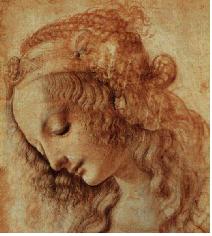
Sargent went about his work. It is not an effortless piece. Compare this portrait with one by Giovanni Boldini (1842-1931) above. Boldini could probably churn out his portraits by the dozen. Yet, in this work, there is an accidental feeling of the sitter emerging from the canvass as if she were the equivalent of a sculpture by Rodin coming out of the rock. This sketchiness and translucence in the media is not new at all, we can find it in the studies of the Grand Masters. There is something to be said about unfinished art. It emphasises the design elements. In the portrait of a woman by Leonardo da Vinci
we are led into the face through semi-circular movements, moving to the centre which is the closed eye. The love of the wavy hair signals to us the focus on the composition for its own sake. The sitter perhaps is not as important. Certainly, we find many artists who confronted with sometimes many hours of drawing and painting of a subject, straying into the abstract. In Cecil Beaton’s composition, the architectonics and patterns of the dress seems paramount. For Boldini it was the flourish of the stroke. John Singer Sargent also loves the material. He spent an inordinantly long time in the detail, so that we can sense the volume and touch of the materials. Another factor, is the sex factor. In many of the high society portraits of women we can see that an important visual locus are the neck line and shoulders, and some times the cleavage. We know that despite what we were taught in schools about Victorians being prudes, even the Queen was indulgent when it came to the naked form. Indeed the corset that constrictedand enslaved women, accentuated the bust and bottom, two of the predominant erotic topoi of male fantasies. Not surprisingly in the 21st century, many a high society woman or the equivalent (media celebrity) cannot wait to get their kit off and appear centrefold in Vanity Fair or even Playboy. The dichotomy between clothed and the unclothed of course is no better illustrated by Francisco de Goya (1746-1828) who painted la maja vestida (clothed) and la maja nuda (nude). These portraits may be of the Duchess of Alba.
The juxtaposition of these paintings have an uncanny resemblance to the cut and paste pornographic pictures of celebrities like Britney Spears. The heads are unsettling distinct from the bodies as if they were painted on afterwards. This is quite uncanny, the subject’s head is on another plane. Consider another portrait by Goya.

Monday, 14 June 2010

Broken Umbrellas and Broken Promises


The broken umbrella. What a common sight it is. Now I wonder how many of you have purchased an umbrella with the belief that when there is a spot of rain it will provide cover? Its original function was to shade the user from the Italian sun as a parasol. But later its other function took over. So. There is rain. I am sans umbrella. I make a hasty purchase in a well-known discount store (it could be any). Hey presto, I open it, and it covers me. So far so good. You already know where this is going I suspect. Since we seem to be in the Northern hemisphere's monsoon season, they call it, Summer, I needed the umbrella almost everytime I set foot outside. Now, it worked well when there was just rain, but when the wind picked up. Snap, and then the thing took on the look of a crow with a broken wing. Here I had to make a choice, the umbrella could with one of its ribs apart, still function, but it made me look more like a bum than usual. I continued to use it. Damn society that is what I say, I paid for it, didn't I, I will use it until its dying days - which occurred the very next day. The umbrella was no longer an umbrella. I thought more about what happened. You see what it boiled down to was that I got what I paid for. The umbrella would last only three days max. in windy weather. Who cares if the umbrella is cheap? Well I do. It is a rum way to do business. Why don't they warn the consumer? Call it a temp. umbrella. Maybe a crapella. These crapellae are manufactured in China. Now I do not think for one moment that China is to blame, because they manufacture quality goods too. It is the shops to blame. They do not give a damn. They do not test the goods. They know that if a customer comes back - they will happily replace the crapella. However, few come back, especially if it is raining. Few retain the receipts. Many are simply embarrassed. Who wants to bring a broken crapella back? A wet soggy detestable thing. Who would alternatively have the know-how of being able to repair it? Will it like the broken wing of a crow need a splint? A bandage? No. It is very difficult to fix it. I have tried, believe me, and the results put me further down the rungs of society -- the cheap bastard class. I think it needs a Ludwig Wittgenstein to engineer an umbrella (a crapella) that can stand all that Rear Admiral Beaufort can throw at it. I am thinking that a mint could be made by creating cheap rib attachers - flexi-rib kits can be bought from the Oblomov catalogue. It would be like the bicycle puncture kit. Simple. Really? Anyway, the thought of a fixed crapella has me smiling. Imagine the scene of some poor consumer being soaked after a crapella has decided on a new origami configuration - then here I come. Three snaps and the flexi-rib is in place. "I am singing in the rain...."

Tuesday, 8 June 2010

The novel and its designs.


Starting a novel is the easiest thing to do. Finishing is something quite else. Getting it published another matter still. Finally bringing the beloved reader to open the pages and READ. Now that needs a miracle these days, as everyone is so distracted. I was told, and I am repeating myself here, never write about writers. However, I find all those novels that have writers as focalizers or characters, to have that little extra attraction, like chili in tomato soup. I think the reason behind this attraction, is the feeling a writer's presence will provide an additional level. We become aware of the writing process, and can enjoy this in tandem with the story. The old metanarrative line. Of course, when the writer ODs on writing, then it takes you away from the READING. Those two Barthian elements, the writable and the readable are definitely palpable. When I start a novel ( I have started so many that it is like trying to jumpstart an old Vauxhall Viva in the midst of Winter), I generally have a design in mind. Maybe I become overwhelmed by the architecture - certainly in the case of New Cynics a novel that was a palimpseste on top of the original Cynics novel (one that is a work of genius) by Anatole Mariengoff. I started with a metaphor of Russia of the past as being like an unmade bed as to bridge the cynics of the NEP and my new cynics of the 1990's. The bed and its contours represented the geography of Russia, and then the focus shifted to the stains of lovemaking, to the visceral presence of the two principals, Vladimir and Olga. The novel also used the collage technique of John Dos Passos whose USA is still a hugely underestimated modernist masterpiece. Since the novel was set in Japan in the near future in the 1990's (at that time), the fillers were all futuristic, like a Japanese student who managed to get a car to run on Diet Coke.
At the centre of the novel was quite literally the erotics of writing. Vladimir the short-story writer was living off the earnings of Olga who worked in a club. In a section that follows the camera of the narrator, we follow him all the way to a sex act on stage. Not knowing that the act involves his wife, Olga. She shouts at him, just like in those many scenes where a home movie ends when a partner turns on the filmmaker and asks him what is he doing? We discover that Olga is working for the Mafia. She is owned. Vladimir tagged along. He is in a manner pimping his wife, and here the metaphor of pimping is critical of the writing process as appropriation or possession of people. The two living in Japan feel alienated. They want to escape. That is the engine of the novel. However, throughout, we get sections that include short stories and essays written by Vladimir. The stories are short and rewritings of folk tales. It was certainly not going to get from A to B quickly, yet the detective novel genre influenced the teleology. We have a character who follows them. He is the watcher. He has tattoos on his eye lids. Two knives that he keeps in his boots - called Mummy and Daddy. The novel was started. But it was beached by Life. Maybe the events in the interlude have over taken it, dated it. However, it is still there, in the consciousness. Olga and Vladimir will have their day. We shall see.