
This is a photograph of Princess Margaret by the fashion and portrait photographer Cecil Beaton (1904-1980). It has much in common with the earlier photographs of royals like this of one by Jack Stack Lauder of the future Queen Mary, Princess Victoria of Teck below. Both photographs are intended
to promote the sitters as fashionable and feminine. However, despite having modern hair styles, both princesses have anachronistic and very formal dresses. In the case of Princess Victoria the corset is constricting like one we would expect of the mid-Victorian period. Despite so many innovations, Beaton’s photograph has the design typical of a staged painting. Interestingly, the John Singer Sargent (1856-1925) paintings seem to have taken their cue from portrait photographs. As in this one:
Sargent was undoubtedly one of the greatest portrait artists of the late nineteenth century. His compositions while based perhaps on photographs, has colour and texture masses that remind us that realism is not an end anymore. Perhaps it never was. There is a seriousness in how
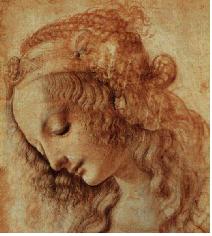
Sargent went about his work. It is not an effortless piece. Compare this portrait with one by Giovanni Boldini (1842-1931) above. Boldini could probably churn out his portraits by the dozen. Yet, in this work, there is an accidental feeling of the sitter emerging from the canvass as if she were the equivalent of a sculpture by Rodin coming out of the rock. This sketchiness and translucence in the media is not new at all, we can find it in the studies of the Grand Masters. There is something to be said about unfinished art. It emphasises the design elements. In the portrait of a woman by Leonardo da Vinci
we are led into the face through semi-circular movements, moving to the centre which is the closed eye. The love of the wavy hair signals to us the focus on the composition for its own sake. The sitter perhaps is not as important. Certainly, we find many artists who confronted with sometimes many hours of drawing and painting of a subject, straying into the abstract. In Cecil Beaton’s composition, the architectonics and patterns of the dress seems paramount. For Boldini it was the flourish of the stroke. John Singer Sargent also loves the material. He spent an inordinantly long time in the detail, so that we can sense the volume and touch of the materials. Another factor, is the sex factor. In many of the high society portraits of women we can see that an important visual locus are the neck line and shoulders, and some times the cleavage. We know that despite what we were taught in schools about Victorians being prudes, even the Queen was indulgent when it came to the naked form. Indeed the corset that constrictedand enslaved women, accentuated the bust and bottom, two of the predominant erotic topoi of male fantasies. Not surprisingly in the 21st century, many a high society woman or the equivalent (media celebrity) cannot wait to get their kit off and appear centrefold in Vanity Fair or even Playboy. The dichotomy between clothed and the unclothed of course is no better illustrated by Francisco de Goya (1746-1828) who painted la maja vestida (clothed) and la maja nuda (nude). These portraits may be of the Duchess of Alba.
The juxtaposition of these paintings have an uncanny resemblance to the cut and paste pornographic pictures of celebrities like Britney Spears. The heads are unsettling distinct from the bodies as if they were painted on afterwards. This is quite uncanny, the subject’s head is on another plane. Consider another portrait by Goya.




No comments:
Post a Comment